
Employee Recognition
Dealership Service Department Retention: Recognition for Advisors and Technicians
A practical recognition playbook for dealership groups that want to improve service advisor and technician retention across busy fixed operations teams.
Service departments run on trust, speed, and consistency. Advisors need to keep customers calm when repairs get complicated. Technicians need to hit quality standards under pressure. Managers need the whole team moving together, even when the workshop is short-staffed and bookings are stacked.
That is why dealership service department retention cannot be treated as a generic HR problem. Fixed ops teams experience a different rhythm from sales, head office, or corporate roles. The work is physical, customer-facing, time-sensitive, and often invisible until something goes wrong.
For large dealership groups and OEM networks, recognition is one of the fastest ways to reinforce the behaviours that keep service teams stable: clear communication, quality workmanship, customer empathy, teamwork, and manager consistency.
Why Service Department Retention Is So Hard
Service advisors and technicians sit at the centre of dealership pressure. They deal with customer frustration, parts delays, warranty complexity, diagnostic uncertainty, productivity targets, and constant handoffs between departments.
When that work is only noticed during complaints, people learn a clear lesson: the business sees errors, not effort.
- Technicians want their craft, accuracy, and problem-solving to be visible.
- Service advisors want the emotional labour of customer communication to be understood.
- Managers need practical ways to lift morale without adding another meeting.
- Dealer principals and group leaders need consistent standards across every rooftop.
Recognition does not solve every retention issue. Pay, workload, tools, rostering, and career pathways all matter. But recognition gives leaders a daily mechanism to make good work visible before people disengage.
The Behaviours Worth Recognising in Fixed Ops
The mistake many dealerships make is recognising only outcomes: the highest hours, the best CSI score, the biggest upsell, the cleanest month-end number. Outcomes matter, but culture is built by the behaviours that create those outcomes repeatedly.
1. Customer communication under pressure
Service advisors are often the face of delays they did not create. Recognise moments where advisors explain options clearly, reset expectations early, calm a difficult conversation, or protect trust when the answer is not what the customer wanted.
2. Quality workmanship that prevents rework
Technician recognition should go beyond speed. Celebrate accurate diagnosis, clean handovers, safety checks, mentoring apprentices, and the extra attention that prevents a customer from coming back with the same issue.
3. Teamwork between advisors, parts, and workshop
Fixed ops breaks down when departments operate in silos. Recognise the parts interpreter who chased an alternative supplier, the foreman who helped an advisor explain a complex job, or the technician who flagged a delay early enough to protect the customer experience.
4. Consistency during busy periods
The busiest weeks reveal the real culture. Recognise people who keep standards high when capacity is tight: clear notes, clean bays, proactive updates, safe work practices, and steady support for newer team members.
A Practical Recognition Rhythm for Service Teams
Recognition needs to fit the way service departments actually work. Long ceremonies and corporate programs will not survive the morning rush. Keep the rhythm simple, visible, and manager-led.
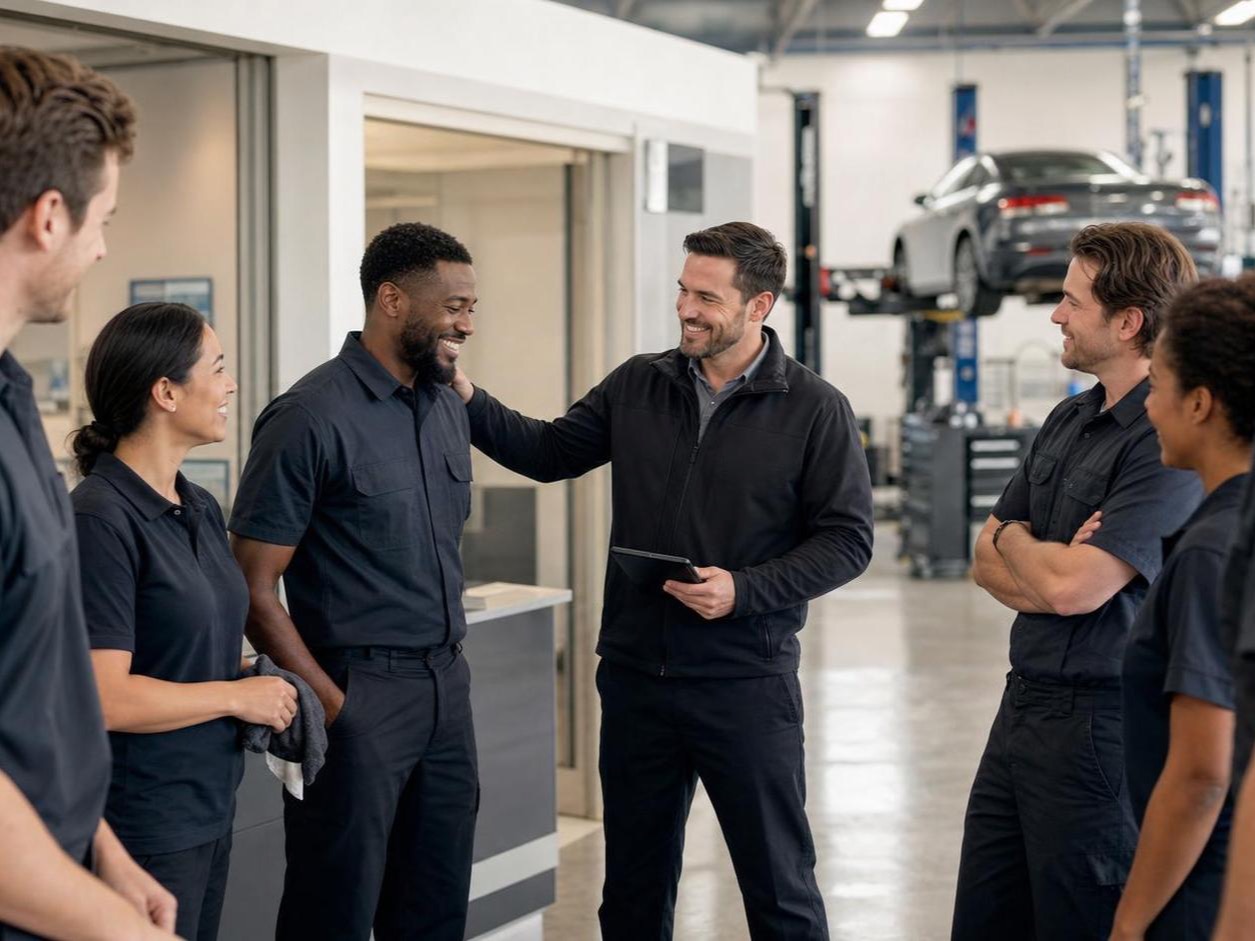
Daily: one specific shoutout in the morning huddle
Start with one example from the previous day. Name the person, the behaviour, and the impact.
Example: “Shoutout to Maya for calling three customers before 9am when parts were delayed. That protected trust and gave the team breathing room before the phones got busy.”
Weekly: recognise one cross-functional win
Pick one moment where service, parts, workshop, or sales worked together to solve a customer problem. This reinforces the idea that the customer experience belongs to the whole dealership.
Monthly: surface patterns across locations
For dealership groups, the biggest advantage comes from visibility across rooftops. Which locations are recognising quality behaviour consistently? Which managers are building the habit? Which service values are showing up often, and which are being missed?
Recognition Templates for Service Managers
Good recognition is specific enough that the behaviour can be repeated. These templates are simple enough to use in a huddle, a team channel, or a mobile recognition platform.
- For service advisors: “Shoutout to [Name] for [specific customer communication]. You helped [customer/team outcome] by [impact]. That is exactly the standard we want in service.”
- For technicians: “[Name], your work on [job/repair] showed real care. The way you [specific behaviour] helped us avoid [risk/rework/delay]. Thank you for setting the quality bar.”
- For parts and workshop teamwork: “Thanks to [Name/Team] for jumping in on [situation]. That handoff helped us [customer or operational outcome] and kept momentum across departments.”
- For apprentice development: “Shoutout to [Name] for taking time to coach [person/team] on [skill]. That builds capability beyond one job and makes the whole workshop stronger.”
What Dealer Groups Should Measure
If recognition is going to improve retention, leaders need to measure whether the habit is reaching the people most at risk of feeling unseen.
- Recognition coverage: What percentage of service advisors, technicians, apprentices, and parts employees were recognised this month?
- Manager consistency: Which service managers are recognising weekly, and which locations are quiet?
- Behaviour mix: Are you recognising only sales or productivity, or also quality, teamwork, safety, and customer communication?
- Early-tenure visibility: Are new starters receiving meaningful recognition in their first 30, 60, and 90 days?
- Retention signals: Compare recognition participation with absence, engagement pulses, internal movement, and turnover by location.
The Leadership Payoff
In a single rooftop, recognition helps people feel valued. Across a dealership group, it does something bigger: it turns local examples of great service into shared operating standards.
That matters because culture in fixed ops is not built from head office announcements. It is built in the moments managers choose to notice: the clean handover, the honest customer update, the technician who helps an apprentice, the advisor who absorbs pressure without passing it on.
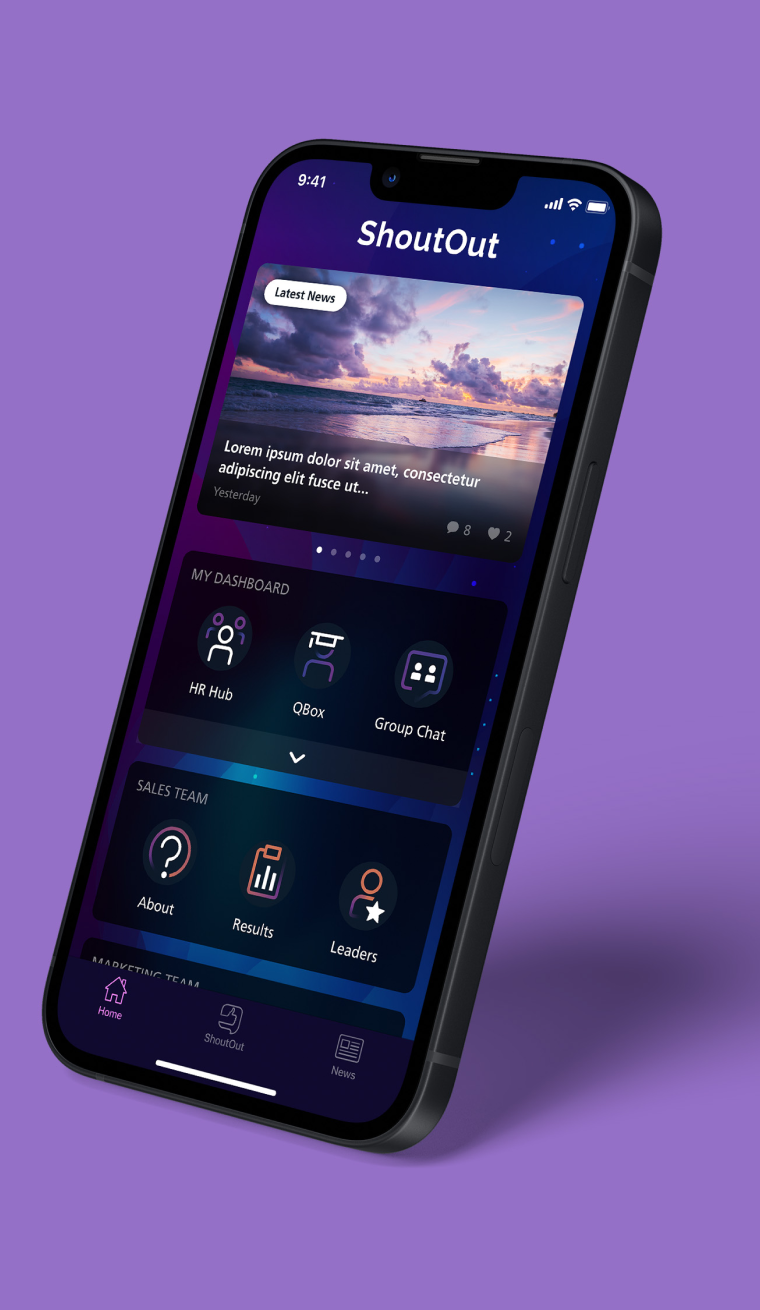
ShoutOut helps dealership groups make those moments visible across every location, so recognition becomes a repeatable management habit rather than a once-a-year award.
If your service department is fighting turnover, start by making the work worth staying for visible every week.